What Standards Must Safety Footwear Meet?
Why Safety Footwear Standards Matter More Than You Think
Ever bought a pair of work boots and wondered if they really protect you? You’re not alone. Safety footwear isn’t just about looking rugged; it’s about protecting your feet from crushing, punctures, slips, and electrical hazards. One wrong step—or one substandard pair—can lead to serious injury.
That’s why safety footwear standards exist. They ensure that the boots or shoes you wear at work actually do what they’re supposed to: keep you safe.
But here’s the tricky part—standards aren’t universal. Depending on where you live and what industry you work in, the required certifications differ.
Let’s break it down.
The Most Common Safety Footwear Standards Around the World
1. ASTM F2413 – USA
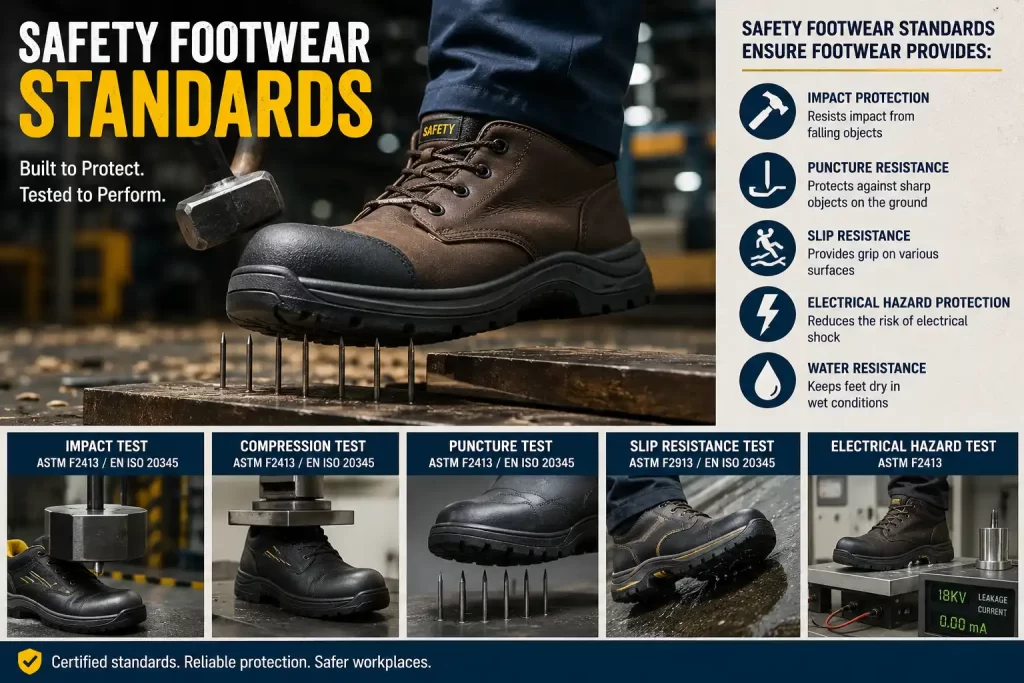
In the United States, ASTM International sets the benchmark for work boots. The ASTM F2413 standard defines minimum requirements for:
- Impact resistance: Protects against heavy objects falling on your toes.
- Compression resistance: Prevents crushing from heavy loads.
- Metatarsal protection: Optional, shields the top of your foot.
- Puncture resistance: Guards against nails and sharp objects.
- Electrical hazard protection: Reduces risk of electrocution.
Here’s a helpful way to remember it: boots get codes like ASTM F2413-18, where the numbers indicate the latest revision. The standard tells you exactly what hazards the footwear can handle.
2. EN ISO 20345 – Europe
In Europe, the EN ISO 20345 standard is king. It’s recognized across the EU and UK. Shoes must have steel or composite toes capable of withstanding 200 joules of impact.
Other classifications include:
- SB: Basic safety requirements
- S1: SB + antistatic, closed heel, energy absorption
- S2: S1 + water resistance
- S3: S2 + puncture-resistant sole and cleated outsole
So, if you’re buying boots in Germany, France, or the UK, look for the EN ISO 20345 marking. That’s your safety guarantee.
3. CSA Z195 – Canada
Canada’s standard, CSA Z195, is similar to ASTM but uses slightly different testing protocols. It categorizes footwear by protection type:
- Grade 1: Industrial use, high protection
- Grade 2: Lighter industrial work
- Green patch: Metatarsal protection included
CSA-certified boots are mandatory in many industrial workplaces in Canada, so workers know exactly what level of protection they have.
4. AS/NZS 2210 – Australia & New Zealand
Down under, AS/NZS 2210 governs safety footwear. It’s recognized in both Australia and New Zealand and includes protection for:
- Impact & compression
- Slip resistance
- Electrical hazards
- Water resistance
The marking usually reads AS/NZS 2210.3:2019, indicating it meets the third part of the standard for occupational footwear.
5. Slip Resistance Ratings – Worldwide Concern
Many standards now include slip resistance tests. A boot that fails a slip test may look solid, but on wet or oily surfaces, it’s practically useless. Ratings usually involve testing on:
- Steel floors with glycerol
- Ceramic tiles with detergent
If your job involves slippery environments—kitchens, factories, warehouses—slip-resistant soles are non-negotiable.
How Safety Footwear Standards Translate to Real-World Protection
Let’s be honest: knowing the standards is one thing. Feeling safe in your shoes is another.
When you pick certified safety footwear:
- You reduce accident risks: Falling tools, heavy machinery, or sharp objects can’t harm you as easily.
- You improve comfort and compliance: Properly rated shoes are tested for both protection and wearability.
- You avoid legal headaches: Many workplaces require certified footwear to meet OSHA, EN, or CSA regulations.
Think of it like seat belts in cars: they work best when certified, properly used, and maintained. Safety shoes are no different.
Buying Tips: Don’t Just Look at the Label
A few pointers that even experienced buyers forget:
- Check the revision date – Standards are updated; an old certification may not meet current requirements.
- Look for the hazard codes – Impact, compression, puncture, electrical, water resistance, etc.
- Fit matters – A certified boot that doesn’t fit is almost as dangerous as no boot.
- Inspect materials – Leather, composite, steel, rubber—all affect comfort and protection.
- Consider the environment – Wet, oily, hot, cold, or electrical hazards should guide your choice.
Common Misconceptions About Safety Footwear Standards
- “All steel toe boots are automatically safe.” False. Only certified footwear meets tested standards.
- “Composite toe shoes are weaker.” Nope. Certified composite footwear can meet the same impact standards as steel.
- “Slip-resistant soles aren’t important.” Absolutely critical. Slips and falls are a leading cause of workplace injuries.
- “Standards are optional.” In many workplaces, wearing non-certified footwear is a violation of safety protocols.
Why Certification Is Worth the Investment
Safety footwear may seem pricey, especially high-end boots. But consider the alternative: workplace injuries, medical bills, lost time, and even permanent disability. Certified shoes are insurance for your feet.
Plus, many certified boots now combine lightweight materials, cushioning, and ergonomic designs. You don’t have to sacrifice comfort for safety.
FAQs About Safety Footwear Standards
1. What does ASTM F2413 certification mean?
It shows the footwear meets U.S. standards for impact, compression, puncture, and optional electrical protection.
2. How can I tell if shoes meet EN ISO 20345?
Look for markings like S1, S2, or S3 on the tongue or inside the boot, showing the level of protection.
3. Are CSA Z195 and ASTM F2413 interchangeable?
Not exactly. They have different testing protocols, but both ensure industrial protection. Verify based on workplace requirements.
4. Do slip-resistant shoes fall under these standards?
Yes, most modern standards test for slip resistance, but always check the specific rating for your work environment.
5. Can I wear non-certified boots at work?
Legally, it depends on your country and employer. Many workplaces mandate certified footwear for safety compliance.